
Football Intelligence
Live Scores vs Official Results: Why Football Data Can Change After a Match
By Sara A.
23 October 2026
7 min read
Last updated: 27/10/2026
Sources & References
Links cited in this article. A citation does not imply independent verification of every claim.
Understand why live scores and official results can differ, how VAR and match status matter, and how to report a traceable correction.
A football score on a screen is a record of what a service currently knows. An official result is a decision recorded by the relevant match officials and competition. Those two things often agree, but they are not the same object. Understanding the difference helps you decide when a live update is useful, when to wait and what evidence to cite after the match.
This guide explains how to read Football Matter's live information without treating a fast update as a guarantee. It also explains the checks available in our implementation and the limits those checks cannot remove. It is an explanation of the service, not a claim that every historical record has already been independently verified.
Start with three different questions
When checking a match, ask what happened on the field, what the data provider currently reports and what the competition has officially recorded. A discrepancy can arise at any boundary between those questions. A correct observation may not yet have reached the feed. A provider amendment may not yet have reached a stored record. A stored amendment may not yet appear in an already open page.
That distinction gives you a useful troubleshooting order. First confirm that you are looking at the right fixture, teams, competition and date. Next look at its status, not only its score. Then compare the provider information with an official competition or club match record. A screenshot of an earlier live display can show what was displayed; it cannot by itself establish the official outcome.
A match clock is not a delivery timestamp
A goal event can carry a playing minute while the request containing it arrives later. The playing minute describes the event's position in the match. The response arrival time describes a computer exchange. Neither is a promise that every other event or statistic in the response has reached its final form.
Football Matter's live website components typically request refreshed data every 30 seconds. That describes a browser polling interval, not a guaranteed time from a real-world incident to your screen. The full path also depends on provider availability, a successful backend update and the next relevant display request. A network interruption can make an open screen older than its visual appearance suggests. Refreshing does not create information the service has not yet received.
Why a goal can disappear from a live score
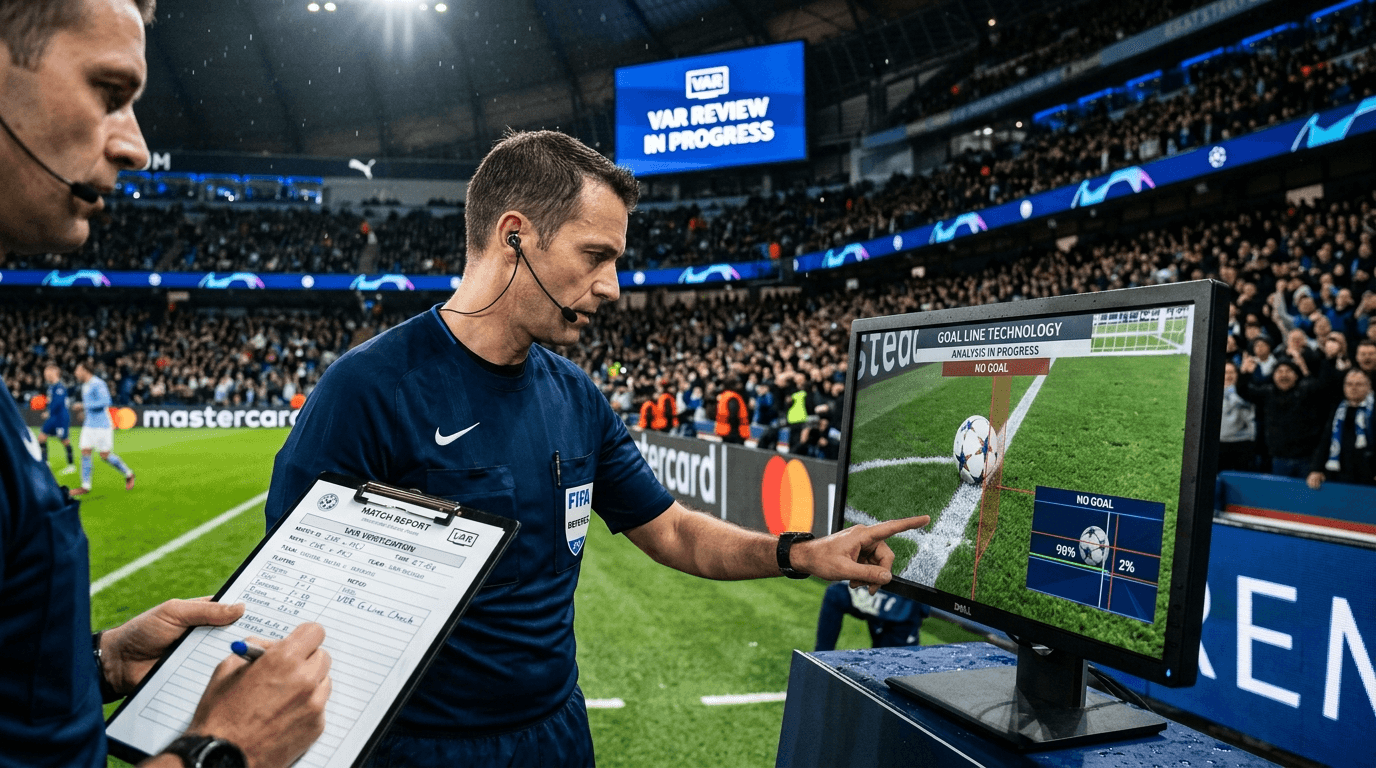
The IFAB VAR protocol explains that video officials assist the referee, who remains responsible for the final decision. A goal-related incident can therefore lead to a decision being checked and changed. The football decision and the data update are separate events: the provider must represent the revised decision, and a consumer must process it.
It is sensible to treat a newly displayed goal as provisional while a review is unresolved. That does not mean guessing whether the goal will stand. It means retaining the uncertainty until the relevant decision appears. A useful explanation says that a score has been amended and identifies the evidence. It should not invent an offside, foul or handball merely because the total changed.
Score, event list and statistics are different records
A scoreline answers a narrow question. An event list adds who, when and what kind of incident. A statistics panel describes another set of observations. These records should be checked for consistency, but they need not arrive as one perfectly simultaneous update.
In our backend, live-score synchronization updates stored fixtures and processes available match events. That structure makes it possible for the fixture record and the event collection to be handled separately. It does not establish a universal order for provider amendments. If a displayed scorer or event detail is missing, the responsible statement is that it is unavailable, rather than supplying a plausible name from the squad.
Finished, postponed and abandoned mean different things
A postponed fixture is not a completed match with no goals. An abandoned match is not safely described as a normal final result just because play stopped. The status is essential context for interpreting the numbers attached to the fixture.
IFAB Law 7 discusses abandoned matches and the role of competition rules or organisers in determining what follows. Readers should therefore consult the specific competition's decision before assuming that an interrupted match will be replayed, resumed or awarded. This guide does not prescribe an outcome for any named fixture. Football Matter's reconciler excludes several postponement and abandonment statuses from its stale in-progress retry set; those cases require appropriate provider or competition updates rather than an invented finish.
What Football Matter reconciliation actually checks
Our reconciliation service looks for selected fixtures whose scheduled kickoff is in the past and whose stored state has not become final. It requests information by fixture ID, subject to retry spacing and call limits. The purpose is to revisit fixtures that may have been missed or left in an in-progress state.
That is a targeted repair mechanism. It is not proof that every score has been checked against an official competition publication. Its coverage depends on configuration, provider access and successful execution. A record can remain stale if the service cannot obtain an update. Explaining this limitation is more useful than calling every stored score verified simply because a reconciliation function exists.
League tables can introduce another layer
Our code can rebuild derived standings for configured single-table competitions from completed fixtures in the database. That can help when current provider standings are unavailable. The derived ordering uses points, goal difference and goals scored; it is an approximation rather than a claim to implement every competition's official tiebreak procedure.
A score amendment can therefore matter beyond the match page. It may affect the inputs to a later table rebuild. A separately imposed deduction or competition ruling may require evidence not represented by summing match results. Use the season selector, check whether the table is derived and consult official regulations before interpreting a disputed position as definitive.
A practical way to check a disagreement
Open the fixture through Matches. Confirm the participants, competition, scheduled time and status. Note precisely which item is disputed: the total, scorer, card, minute or a statistic. Compare the same fixture with an official match record. If you report an error, include the Football Matter URL and the supporting source, rather than only saying the score is wrong.
Avoid combining values from different moments. An earlier event list and a later scoreline may not describe the same update state. If the supporting record is itself provisional, say so. The aim is a traceable correction, not a confident explanation unsupported by evidence.
What to cite after the match
For an official result, prefer the competition's published record or decision. For a statement about what Football Matter displayed, identify the page and observation time. For a model estimate or derived statistic, identify its scope and method. These are different kinds of claims and should have different evidence.
Our methodology explains the distinction between data and interpretation. Our editorial policy explains sourcing and corrections. A useful live service helps you follow a match; a trustworthy account also tells you when its information needs another check. Waiting for a supported final record is part of following the game accurately.
Preserve the correction trail
Keep a short note of the disputed value, the time you saw it and the URL you used. If a later value differs, record that separately rather than overwriting your first note. Then identify the official record supporting the final statement. This separates a display observation from an outcome claim and helps an editor reproduce the issue. It also prevents an old screenshot circulating as if it represented the service's current information. Share only the detail needed to explain the discrepancy.
A finished score may need a separate correction
A later ruling about a completed match may need a separate correction. The stale-fixture pass targets unfinished states rather than continuously revisiting every final result. Keep the competition decision and fixture reference together when reporting an amendment. A successful retry elsewhere does not establish that this particular finished score has been checked.
Sources & References
- IFAB Law 5: the referee
- IFAB VAR protocol
- IFAB Law 7: duration and abandoned matches
- API-Football documentation
- Football Matter implementation evidence: `app/jobs/live_score_sync.py`, `app/services/fixture_reconciler.py`, `frontend/src/lib/cache-config.ts`. These source pointers are editorial review evidence, not an assertion that all production jobs are operating successfully.
Loading reactions...
Sara A.
Football Features Writer
Sara covers the stories behind the stats - from transfer sagas to player journeys - with warmth and depth.
3 articles published
Discussion Arena
Tactical analysis is only half the match. Join the FootballMatter community in the arena to share your insights, debate the strategy, and challenge other tactical minds.
Related Analyses

This Day in Football
29 Oct 2026
5 min read
Chelsea under the spotlight on October 29 2026
On Oct 29 2026 Chelsea face a penalty controversy, a sidelined forward and a women's side that keeps winning. All the stories you need today.
Written by Marcus
0
0
READ FULL ARTICLE →

Player Spotlight
28 Oct 2026
5 min read
Lazio's Midfield Maestro: How Ciro Immobile is Redefining the Role
Ciro Immobile is not just a striker. In the 2026/27 season, he is Lazio's engine room. We break down his shadow play and impact.
Written by Marcus
0
0
READ FULL ARTICLE →

Football Intelligence
27 Oct 2026
5 min read
Reading the Early Ligue 1 Table: Why Seven Matches Establish the Tactical Baseline
An analytical breakdown of the Ligue 1 table after seven matches, exploring tactical baselines, pressing trade-offs, and the limitations of early season data.
Written by Sara
0
0
READ FULL ARTICLE →